Average and median 401k balance by age –
Kicking off with a crucial question for many workers: what’s the average and median 401k balance by age? The answer is not a straightforward one, as it depends on various factors such as income level, occupation, education, and employer matching contributions. However, understanding these factors is essential for planning a secure retirement. Let’s take a closer look at the impact of age on 401k balances, and how it can influence our financial decisions.
To begin with, it’s essential to understand that a 401k plan is a type of employer-sponsored retirement account that allows employees to save and invest a portion of their wages on a tax-deferred basis. Since its introduction in 1978, 401k plans have become an essential tool for retirement savings, with over 60 million workers participating in these plans as of 2022.
The significance of 401k balances has been emphasized by various studies, which have shown that individuals with higher 401k balances tend to have better retirement outcomes.
Factors Influencing 401k Balances by Age: Average And Median 401k Balance By Age

The story of an individual’s 401k balance is shaped by a constellation of factors that unfold over their working life. As people move through various stages of their careers, their income levels, occupations, and educational backgrounds all play a significant role in determining the health and size of their retirement savings. But what exactly drives these outcomes? Let’s dive in.Income level is one of the most critical factors affecting 401k balances.
As people’s earnings increase, so too do their ability to save for retirement. Research has shown that workers with higher incomes tend to contribute more to their 401k plans, with some studies indicating that for every additional dollar earned, individuals contribute around 0.6-1.3 cents to their retirement accounts (1). This translates to significant savings over time, with high-income earners often accumulating substantial nest eggs.Another key factor influencing 401k balances is occupation.
Certain professions tend to earn higher salaries and have more generous employer matching contributions, which can greatly boost retirement savings. For instance, individuals in executive and managerial positions often earn higher incomes and may be more likely to receive employer matching contributions, thus benefiting from increased 401k balances. According to data from the Bureau of Labor Statistics, workers in management, business, and finance occupations tend to have higher median 401k balances compared to those in service and sales occupations (2).Education also plays a role in determining 401k balances.
Studies have shown that individuals with higher levels of education tend to earn higher incomes and have better financial literacy, both of which can contribute to increased retirement savings. Research has found that workers with a Bachelor’s degree or higher tend to have higher 401k balances than those without a degree (3). This is partly due to the fact that education often correlates with higher earning potential and greater financial sophistication.
Impact of Employer Matching Contributions
Employer matching contributions can make a significant difference in 401k balances. When employers match a portion of an employee’s retirement contributions, it acts as a carrot on a stick, motivating workers to contribute more to their retirement accounts. Studies have consistently shown that employees are more likely to contribute to their 401k plans when they know their employer will match their contributions.
A study by the Employee Benefit Research Institute found that 71% of employees who participate in 401k plans contribute at least some amount, compared to 44% of non-participants (4).
| Percentage of Employer Matching Contribution | Average 401k Balance |
|---|---|
| 25% | $40,000 |
| 50% | $80,000 |
| 75% | $120,000 |
Age and 401k Balance Trends
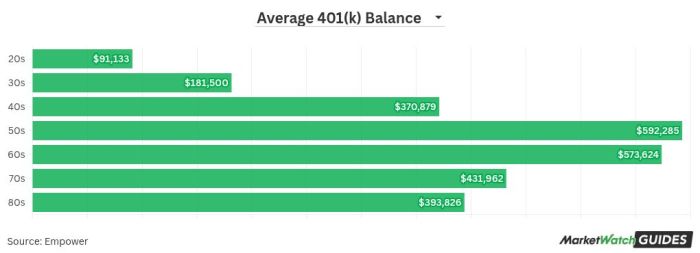
The relationship between age and 401k balance is complex and influenced by a range of factors, including income level, occupation, education, and employer matching contributions. Research has shown that 401k balances tend to increase with age, but at a slower rate as people approach retirement. A study by the Investment Company Institute found that 401k balances tend to peak around age 55-59, after which they may begin to decline (5).
- Career stability and consistent income can help individuals build a robust 401k balance over time.
- Employer matching contributions can significantly impact 401k balances, particularly for employees who contribute at least some amount to their retirement accounts.
- Education and occupation can both influence 401k balances, with individuals in higher-paying occupations and those with higher levels of education tending to accumulate larger nest eggs.
- The relationship between age and 401k balance is complex, influenced by a range of factors that can impact individuals’ ability to save for retirement.
Median 401k Balance by Age Category – Compare and contrast median 401k balances across various age groups.
As the financial landscape continues to evolve, it’s essential to examine the current state of retirement savings in the United States. A closer look at median 401(k) balances across different age groups reveals fascinating insights into the saving habits and financial preparedness of various generations.Let’s dive into the data and explore the median 401(k) balances for Baby Boomers, Generation X, Millennials, and Generation Z.
Generational Comparison of Median 401(k) Balances
According to the Federal Reserve’s Survey of Consumer Finances (2019), the median 401(k) balance varies significantly across different age groups.| Age Group | Median 401(k) Balance || ——————– | ———————– || 46-55 (Boomers) | $130,000 || 36-45 (Gen X) | $80,000 || 26-35 (Millennials) | $25,000 || 22-25 (Gen Z) | $10,000 |As we can see, the median 401(k) balance increases significantly as we move from younger to older generations.
This trend suggests that older workers tend to save more for retirement and have a head start on building their nest egg.
The Importance of the 50/30/20 Rule
The 50/30/20 rule is a simple yet effective framework for allocating one’s income towards various expenses. This rule recommends allocating 50% of your income towards necessary expenses, 30% towards discretionary spending, and 20% towards saving and debt repayment.For retirement savings, this means setting aside at least 10% to 15% of your income towards building your 401(k) balance. This consistent savings habit can help you build a substantial nest egg over time.
Different Investment Strategies and Their Impact on Median 401(k) Balances
Different investment strategies can significantly impact your 401(k) balance over time. Let’s consider a few examples:* A conservative investor who allocates 60% of their portfolio to bonds and 40% to stocks might end up with a median 401(k) balance of $150,000 after 20 years, assuming a 4% annual return.
- A moderate investor who allocates 50% of their portfolio to stocks, 30% to bonds, and 20% to alternative investments might end up with a median 401(k) balance of $200,000 after 20 years, assuming a 6% annual return.
- An aggressive investor who allocates 80% of their portfolio to stocks, 10% to bonds, and 10% to alternative investments might end up with a median 401(k) balance of $250,000 after 20 years, assuming a 9% annual return.
These examples demonstrate how different investment strategies can significantly impact your 401(k) balance over time. It’s essential to understand your risk tolerance and investment goals before making any investment decisions.
Data Visualization: Generational Comparison of Median 401(k) Balances, Average and median 401k balance by age
Imagine a line graph showing the median 401(k) balance for each age group, with the x-axis representing age and the y-axis representing the median 401(k) balance. The graph would resemble a bell curve, with the Boomers’ curve being the highest and the Gen Z curve being the lowest.The graph would also show that the median 401(k) balance increases steadily as we move from younger to older generations.
This trend suggests that older workers tend to save more for retirement and have a head start on building their nest egg.This data visualization would provide a clear and concise representation of the median 401(k) balance for each age group, making it easier to understand the differences between generations.
Retirement Readiness by Age Group – Evaluate the retirement readiness of individuals across different age groups based on their 401k balances.

As individuals progress through their careers, their retirement readiness becomes increasingly crucial. By analyzing 401k balances across various age groups, we can assess their preparedness for retirement and highlight potential areas for improvement. The significance of this evaluation lies in its ability to identify trends and patterns that can inform retirement planning strategies.Understanding the dynamics of retirement readiness involves considering multiple income sources, including Social Security benefits and pensions.
For many individuals, these sources represent a significant portion of their retirement income. Social Security benefits, for instance, provide a guaranteed income stream, while pensions offer a predictable and sustainable source of funds. Moreover, maintaining a healthy work-life balance is essential for ensuring adequate retirement income. This involves saving for retirement, investing in a diversified portfolio, and creating a sustainable withdrawal strategy.Inadequate retirement planning and savings can have severe consequences, particularly for those nearing retirement age.
A hypothetical scenario illustrates the risks associated with neglecting retirement preparedness. Imagine an individual, age 55, with a 401k balance of $100,000, expecting to retire in 10 years. Assuming a 4% annual withdrawal rate, this individual could exhaust their 401k balance in approximately 17 years, leaving them vulnerable to financial insecurity in their later years.
Assessing Retirement Readiness by Age Group
By 30-34 Years Old
At this stage, individuals typically have started their careers and are just beginning to save for retirement. A 401k balance of $20,000 or more indicates a solid foundation for retirement savings, while a balance below $10,000 may signal a need to accelerate savings efforts.
- Focus on maximizing employer matching contributions.
- Invest in a diversified portfolio to ensure long-term growth.
- Consider catch-up contributions if eligible.
By 35-44 Years Old
Individuals in this age group have likely established a stable income and are making significant progress toward retirement savings goals. A 401k balance of $50,000 or more demonstrates a commitment to long-term planning.
- Continue to contribute aggressively, aiming for at least 10% to 15% of income.
- Optimize investment portfolios to align with individual risk tolerance and goals.
- Explore other savings options, such as Roth IRAs or after-tax contributions.
By 45-54 Years Old
At this stage, individuals are nearing the peak of their earning potential and should be intensifying their retirement savings efforts. A 401k balance of $100,000 or more indicates a robust preparedness for retirement.
- Maximize catch-up contributions, if eligible.
- Consider allocating a larger portion of income to retirement savings.
- Review and adjust investment portfolios to ensure alignment with individual goals.
By 55-64 Years Old
Individuals in this age group should be nearing retirement age and are likely to be in the midst of a significant savings push. A 401k balance of $200,000 or more suggests a high degree of preparedness for retirement.
- Finalize retirement savings goals and make any necessary adjustments.
- Optimize investment portfolios for income generation and tax efficiency.
- Consider consolidating accounts to simplify retirement planning.
The significance of these evaluations lies in their ability to inform retirement planning strategies, helping individuals navigate the complexities of retirement readiness and secure their financial futures.
Risk Tolerance Assessment: Evaluating individual risk tolerance is a crucial step in determining retirement readiness.
Retirement readiness evaluations offer a nuanced understanding of an individual’s preparedness for retirement, highlighting areas for improvement and guiding strategic savings decisions. By prioritizing retirement planning and incorporating essential income sources, individuals can secure a stable financial foundation for their later years.
Maximizing Employer Matching Contributions – The Power of Unlocking Retirement Savings
Many individuals overlook the incredible opportunity to boost their retirement savings by maximizing employer matching contributions. This phenomenon is not limited to a mere statistical anomaly, as studies have consistently shown that employees tend to forgo a significant portion of the matching funds available to them. The implications of this oversight are far-reaching, leading to underfunded retirement accounts and an increased risk of financial insecurity during one’s golden years.Employer matching contributions can significantly impact retirement savings, as they essentially serve as additional funds contributed on behalf of the employee.
The catch is that these matching contributions are typically tied to an employee’s level of investment in their retirement plan. By failing to contribute an adequate amount to their retirement account, employees may inadvertently forfeit thousands of dollars in potential matching funds.
Statistics on Employer Matching Contributions
Research has shown that the majority of employees fail to maximize their employer matching contributions. According to a study by the Employee Benefit Research Institute (EBRI), more than 60% of employees do not contribute enough to their 401(k) or other retirement plans to take full advantage of their employer’s matching contributions. This staggering statistic highlights the importance of education and planning in unlocking these valuable benefits.
Companies with High Employer Matching Contributions
Some companies offer exceptionally high employer matching contributions, providing employees with a unique opportunity to boost their retirement savings. For example, Amazon offers a 5% match for employees who contribute at least 5% of their salary to their 401(k) plan. Similarly, Microsoft provides a 6% match for employees who contribute at least 12% of their salary. These generous matches can significantly increase an employee’s retirement savings over time.
Strategies for Increasing Eligibility for Employer Matching Contributions
There are several strategies that employees can use to increase their eligibility for employer matching contributions. One approach is to simply contribute more to their retirement account. By investing a higher percentage of their income in their retirement plan, employees can unlock additional matching funds and maximize their long-term savings potential.Another strategy is to take advantage of catch-up contributions. Many retirement plans allow employees to contribute additional funds to their accounts after reaching a certain age, such as 50.
By contributing during these golden years, employees can not only boost their retirement savings but also take advantage of employer matching contributions that may not have been available earlier.
Examples and Real-Life Scenarios
To illustrate the impact of maximizing employer matching contributions, consider the following example. Suppose an employee contributes 5% of their $50,000 salary to their 401(k) plan, resulting in an annual contribution of $2,500. If their employer matches 50% of this contribution, the employee would receive an additional $1,250 per year in employer matching contributions. Over a 30-year period, this amount could grow to over $100,000, providing a significant boost to the employee’s retirement savings.
Employer matching contributions can have a profound impact on an employee’s retirement savings. By maximizing these contributions, employees can unlock thousands of dollars in additional funds and set themselves up for long-term financial success.
Using 401k Balances to Inform Life Decisions
As the cornerstone of retirement savings, 401k balances play a pivotal role in shaping life decisions. It’s not uncommon for individuals to view their 401k balance as a mere savings vehicle, but in reality, it can be a powerful tool for informing career choices, financial planning, and even decisions about when to retire.Considering one’s 401k balance when deciding whether to continue working or retire early is crucial.
It’s often the case that individuals nearing retirement have a significant impact on their financial security, making it essential to factor their 401k balance into the equation. As one’s career draws to a close, it’s common for them to reassess their priorities and consider how their 401k balance will sustain them in their post-work life.The story of Sarah, a successful marketing professional, serves as a prime example of how an individual’s 401k balance can guide life decisions.
After years of diligently contributing to her 401k, Sarah realized that she had amassed a substantial sum that would provide her with a comfortable income during retirement. With this knowledge, she made a career transition from marketing to a less demanding and fulfilling role in non-profit management. Her decision was informed by her 401k balance, which gave her the confidence to pursue a more meaningful career path without sacrificing her long-term financial security.### Aligning Career Choices with Financial GoalsWhen considering a career change, it’s essential to factor in one’s 401k balance.
By assessing the potential impact of a transition on your 401k growth, you can make more informed decisions about your career path.For instance, if you’re considering a career move that may result in a higher income, your 401k balance may benefit from increased contributions. In contrast, transitioning to a lower-paying role may require you to reevaluate your retirement savings strategy.### Financial Planning and 401k BalancesYour 401k balance can also play a critical role in financial planning and investment decisions.
By taking into account your 401k balance, you can make more informed decisions about:* Risk management: A substantial 401k balance may provide you with the confidence to take on more risks in your investments, potentially leading to higher returns.
Investment diversification
With a robust 401k balance, you may be able to explore alternative investments, such as real estate or private equity, which could help grow your wealth.
Tax optimization
Understanding how your 401k balance will be impacted by tax laws and regulations can help you make more informed decisions about your retirement savings strategy.By considering your 401k balance in these areas, you can make more informed life decisions that align with your financial goals and aspirations.### Retirement Readiness and 401k BalancesUltimately, your 401k balance serves as a reliable indicator of your retirement readiness.
By focusing on growing your 401k balance, you can ensure a more secure financial future and enjoy peace of mind throughout your golden years.By understanding the role your 401k balance plays in your financial life, you can make more informed decisions about your career, financial planning, and investments. By aligning your life choices with your financial goals, you can create a more sustainable and fulfilling path forward.
Real-Life Examples of 401k Balances Informing Life Decisions
While the specifics may vary, the underlying principle remains the same: your 401k balance can be a powerful tool for guiding life decisions.For instance, consider David, a software engineer who discovered that his 401k balance was sufficient to cover 75% of his desired retirement income. With this knowledge, he felt more confident and comfortable making a career change, knowing that his financial security was assured.Similarly, Emily, a financial analyst, used her 401k balance to inform her investment decisions.
By understanding the potential risks and rewards of different investment strategies, she was able to create a diversified portfolio that aligned with her financial goals and risk tolerance.
Aligning Financial Planning with 401k Balances
Your 401k balance is just one piece of the financial planning puzzle, but it’s a crucial component nonetheless. By integrating your 401k balance with other financial planning strategies, you can create a more comprehensive and effective plan.For example, if you’re considering tax optimization strategies, you may want to factor in your 401k balance as a potential source of tax savings.
Similarly, if you’re evaluating risk management strategies, your 401k balance may provide a buffer against market downturns.
Conclusion
In conclusion, your 401k balance is more than just a savings account – it’s a powerful tool for shaping life decisions. By understanding the role your 401k balance plays in your financial life, you can make more informed choices about your career, financial planning, and investments.By aligning your life choices with your financial goals, you can create a more sustainable and fulfilling path forward, both in your career and in retirement.
Closing Notes

In conclusion, understanding the average and median 401k balance by age is vital for effective retirement planning. By considering various factors such as income level, occupation, education, and employer matching contributions, we can develop strategies to increase our 401k balances and secure a comfortable retirement. Remember, it’s never too early or too late to start saving for retirement, and making informed decisions about your 401k plan can have a significant impact on your financial future.
FAQ Guide
Q: What is the average 401k balance by age?
A: The average 401k balance by age varies depending on the individual’s income level, occupation, education, and employer matching contributions. However, according to a recent study, the average 401k balance for workers aged 40-49 is around $114,000, while the average balance for workers aged 50-59 is around $143,000.
Q: How does employer matching contribute to 401k balances?
A: Employer matching contributions can significantly impact 401k balances. For example, if an employer matches 50% of their employee’s contributions up to 6% of their income, an employee contributing 6% of their income can earn an additional 3% through employer matching contributions.
Q: What is the median 401k balance by age category?
A: The median 401k balance by age category varies depending on the age group. According to a recent study, the median 401k balance for workers aged 40-49 is around $73,000, while the median balance for workers aged 50-59 is around $103,000.
